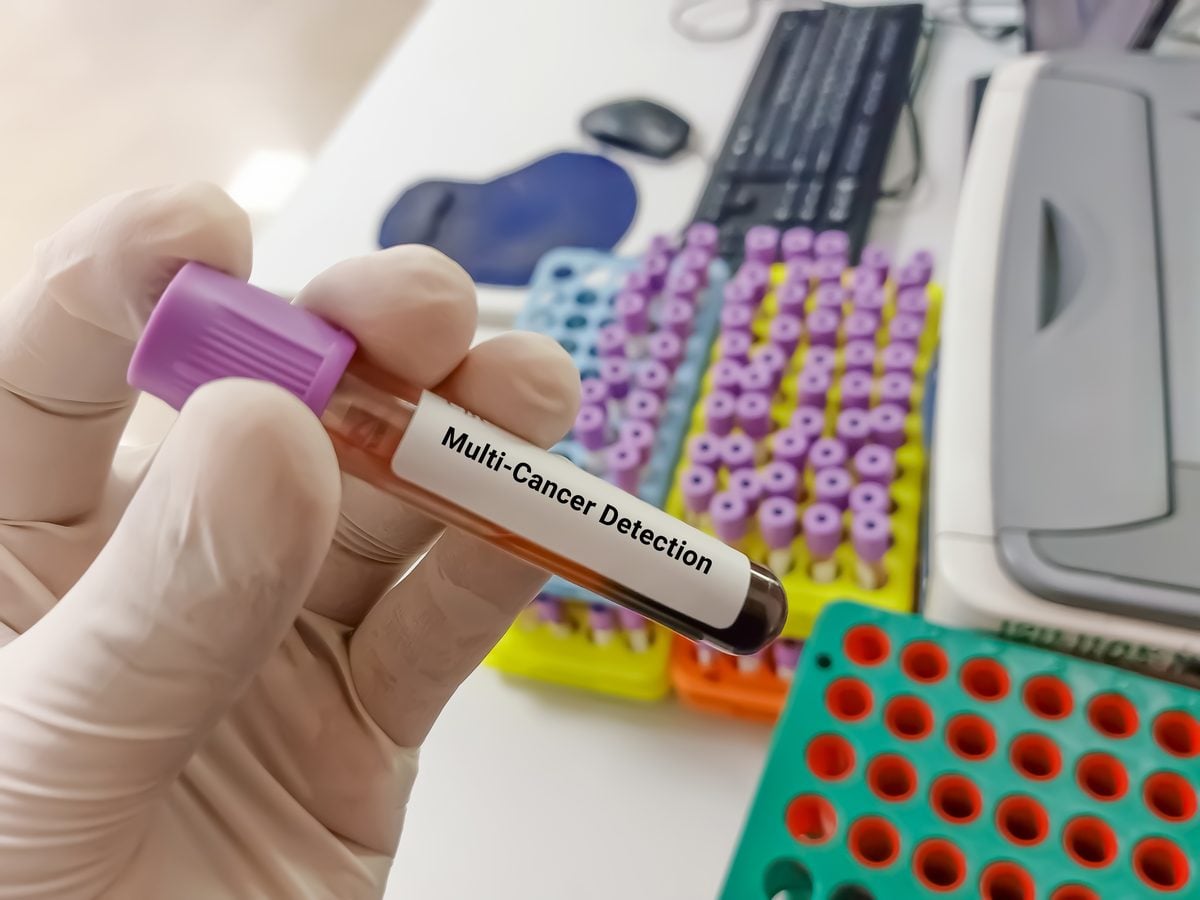
Cancerguard is a blood test that looks for signs of cancer anywhere in the body from a single sample. It launched in September 2025 from Exact Sciences, the company behind the at-home colon cancer screening kit many people already know, and it belongs to a newer category of tests called multi-cancer early detection tests, or MCED tests.
The appeal is easy to understand. One blood draw, and a result that tells you whether a cancer signal was detected. Patients bring this up with us regularly now, usually with a version of the same question: is this enough on its own?
The honest answer is that Cancerguard does something specific and worthwhile, and it also has a clearly defined scope that many people are never told about. This article walks through what the test is, how it works, which cancers it looks for, who it is designed for, and — just as importantly — what sits outside its coverage.
What Cancerguard actually is
Cancerguard is a laboratory-developed test. That means it is produced and run in a single certified laboratory rather than sold as a manufactured kit, and it has not been reviewed or approved by the FDA. This is a normal regulatory pathway for advanced lab tests, but it is worth stating plainly, because a great many patients assume that any test available commercially has been through FDA review. Cancerguard has not, and neither has any other multi-cancer blood test currently on the market.
The test costs somewhere in the range of $659 to $689 depending on the source you read, so around $700 in practice. It is not covered by Medicare or by commercial insurance, and it is ordered through a telehealth portal rather than requiring a visit to your own physician first.
How Cancerguard works
Cancer cells behave differently from healthy cells, and as they grow and die they release material into the bloodstream. Some of that material is DNA. Tiny fragments of tumor DNA — often called circulating tumor DNA, or ctDNA — end up mixed in with the far larger amount of DNA shed by normal cells.
The challenge is telling one from the other, and this is where a chemical process called methylation becomes useful. Methylation is the body’s way of switching genes on and off by attaching small chemical tags to DNA. Cancer cells have distinctive methylation patterns, so reading those patterns can suggest that the DNA came from a tumor rather than from healthy tissue.
Most MCED tests stop there. Cancerguard’s distinguishing feature is that it analyzes multiple classes of biomarker rather than methylation alone — Exact Sciences describes it as the first commercially available multi-cancer test to do so. The idea is that combining several independent signals gives the test more to work with, particularly for cancers that shed very little material.
Everything is then interpreted together, and the result comes back in one of two forms: a cancer signal was detected, or it was not.
What Cancerguard screens for
Exact Sciences reports that the test detects signals associated with more than 50 cancer types, with the panel weighted toward cancers that have no routine screening test and a high mortality burden.
The performance figures come from the company’s development studies. Across the six cancers with the poorest survival rates — pancreatic, lung, liver, esophageal, stomach and ovarian — Cancerguard reported 68% sensitivity, meaning it identified roughly two-thirds of those cancers among people known to have them. Overall sensitivity excluding breast and prostate cancer was reported at 64%, with specificity of 97.4%. It also detected more than one in three of the stage I and II cancers in those studies.
That is a genuinely useful profile, and it is worth noting where the value sits. Pancreatic, ovarian, liver, stomach and esophageal cancers have no routine screening test for the general population. A blood test that can flag some of them earlier is filling a real gap, not duplicating something that already exists.
Who Cancerguard is for
The test is indicated for adults aged 50 to 84 who have not had a cancer diagnosis in the previous three years. Both ends of that range matter.
The lower bound reflects the fact that cancer risk rises with age, and MCED tests perform better in populations where cancer is more common. The upper bound of 84 is a closed ceiling, which differs from how some other tests in this category are framed — a difference we cover in our comparison of Cancerguard and Galleri.
For anyone under 50, the practical consequence is simple: Cancerguard is not available to you. That covers a large share of the people who come to us actively thinking about early detection, including patients in their thirties and forties with a family history that concerns them.
What Cancerguard does not cover
This is the part that most often surprises people, and it comes directly from the test’s own labeling rather than from anyone’s interpretation of it.
Cancerguard is not indicated for breast cancer screening, prostate cancer screening, or the detection of pre-cancerous lesions.
Breast and prostate are the two most commonly diagnosed cancers in the United States. The American Cancer Society projects 321,910 new breast cancer cases and 333,830 new prostate cancer cases in 2026, against roughly 2,114,850 total new diagnoses. That is about 31% of all cancer diagnoses in the country sitting outside what the test is designed to look for.
None of this is a flaw in the test. Both cancers already have established screening pathways — mammography and PSA testing — and Cancerguard is built to complement those rather than repeat them. The problem is only that a patient who receives a “no cancer signal detected” result, and who has not been told about this boundary, may reasonably believe they have been screened for cancer in general. They have not.
The exclusion of pre-cancerous lesions matters too. Cancerguard looks for cancer that already exists. It is not designed to find the changes that come before it — the polyp, the abnormal cervical cells, the early lesion that could be removed before it ever becomes cancer.
What a Cancerguard result means
A result of “no cancer signal detected” means the test did not find what it was looking for in that sample, on that day. It does not mean you do not have cancer. Sensitivity in the 60s means a meaningful share of cancers within scope are missed, and the cancers outside scope were never being looked for in the first place. Standard screening still applies in full.
A result of “cancer signal detected” is not a diagnosis either. It is a finding that requires investigation, and that investigation is almost always imaging. Something has to establish whether anything is physically present, where it is, and what it is.
Where imaging fits
This is the practical link between a blood result and an answer. A blood test reports a chemical trace; it cannot show you a structure. Confirming or ruling out what a signal suggests requires looking at the body itself.
Whole-body MRI approaches the question from the opposite direction. It produces detailed images of the brain, spine, chest, abdomen and pelvis without ionizing radiation and without contrast dye, and our board-certified radiologists review those images for anything abnormal in size, shape or texture. A sequence called diffusion-weighted imaging is part of why densely packed abnormal tissue tends to stand out against its surroundings. Because it looks at anatomy rather than a signal, it does not depend on a tumor shedding anything into the bloodstream.
It has its own boundaries, and we are direct about them. Whole-body MRI is poor at detecting small lung nodules, with published sensitivity around 23%. It does not evaluate the lining of the colon, so it cannot replace a colonoscopy. And a whole-body protocol is not the same study as a dedicated breast or prostate MRI, which require specific positioning and sequences. And there is no published evidence yet that whole-body MRI screening extends life — that research does not exist for any screening MRI protocol or any MCED test.
The useful way to hold all of this is that these tools answer different questions. We work through that comparison in more detail in our guide to cancer blood tests and whole-body MRI.
If you have taken a Cancerguard test, or are considering one, understanding its scope is what makes the result meaningful. A proactive approach to your health works best when you know exactly which questions each test can answer — and which ones it was never designed to ask.
Frequently asked questions
What does the Cancerguard test screen for?
Cancerguard looks for signals associated with more than 50 cancer types, concentrated on cancers that have no routine screening pathway. It is not indicated for breast cancer screening, prostate cancer screening, or detecting pre-cancerous lesions.
How does the Cancerguard blood test work?
It analyzes a blood sample for fragments of tumor DNA and other biomarkers shed into the bloodstream. Rather than relying on methylation patterns alone, Cancerguard examines multiple biomarker classes and combines them into a single result: cancer signal detected, or not detected.
Who is eligible for the Cancerguard test?
It is indicated for adults aged 50 to 84 with no cancer diagnosis in the previous three years. It is not intended for adults under 50.
Is Cancerguard FDA-approved?
No. Cancerguard is a laboratory-developed test and has not been FDA-approved. It is not covered by Medicare or commercial insurance, and the US Preventive Services Task Force has not issued a recommendation on multi-cancer blood tests.
What happens if Cancerguard detects a cancer signal?
A detected signal is not a diagnosis. It prompts further investigation, which typically means imaging to determine whether anything is physically present and where. A negative result does not rule cancer out, and standard screening such as mammography and colonoscopy should continue as normal.
Sources
- Cancerguard™ Clinician Brochure: Test Information for Healthcare Providers — Exact Sciences, 2025
- Cancer statistics, 2026 — CA: A Cancer Journal for Clinicians (American Cancer Society), 2026
- Questions and Answers about Multi-Cancer Detection Tests — National Cancer Institute (Division of Cancer Prevention)
- Multi-Cancer Early Detection Tests: State of the Art and Implications for Radiologists — Radiology (RSNA), 2025
- A and B Recommendations — U.S. Preventive Services Task Force
- Whole-body MRI for opportunistic cancer detection in asymptomatic individuals: a systematic review and meta-analysis — European Radiology, 2026