A new kind of cancer test has arrived, and it is changing the questions patients bring to us. For the first time, you can give a single tube of blood and receive a result that reports whether a cancer signal was detected anywhere in your body. These are called multi-cancer early detection tests, or MCED tests, and two of them — Cancerguard from Exact Sciences and Galleri from GRAIL — are now widely available to people who want them.
The interest is understandable. The idea of catching cancer early, from one blood draw, is genuinely appealing. But we have noticed something in the conversations we have with patients: almost nobody is clear on what these tests actually do, and almost nobody has been told what they do not do. People arrive assuming a blood test is a comprehensive cancer screen. It is something narrower and more specific than that, and understanding the difference matters quite a lot.
This article explains what a multi-cancer blood test can find, what whole-body MRI can find, and where the two approaches genuinely differ. Neither one replaces the other, and neither one replaces the screening your doctor already recommends. But they answer different questions, and knowing which question you are asking is the whole point.
Two different questions
The clearest way to understand the difference is to notice that these tests are not competing to answer the same question.
A multi-cancer blood test asks: is there a signal? It looks for fragments of DNA and other biological markers shed into the bloodstream by tumor cells. If enough of that material is circulating, the test reports that a cancer signal was detected. Some tests also predict where in the body the signal is likely coming from.
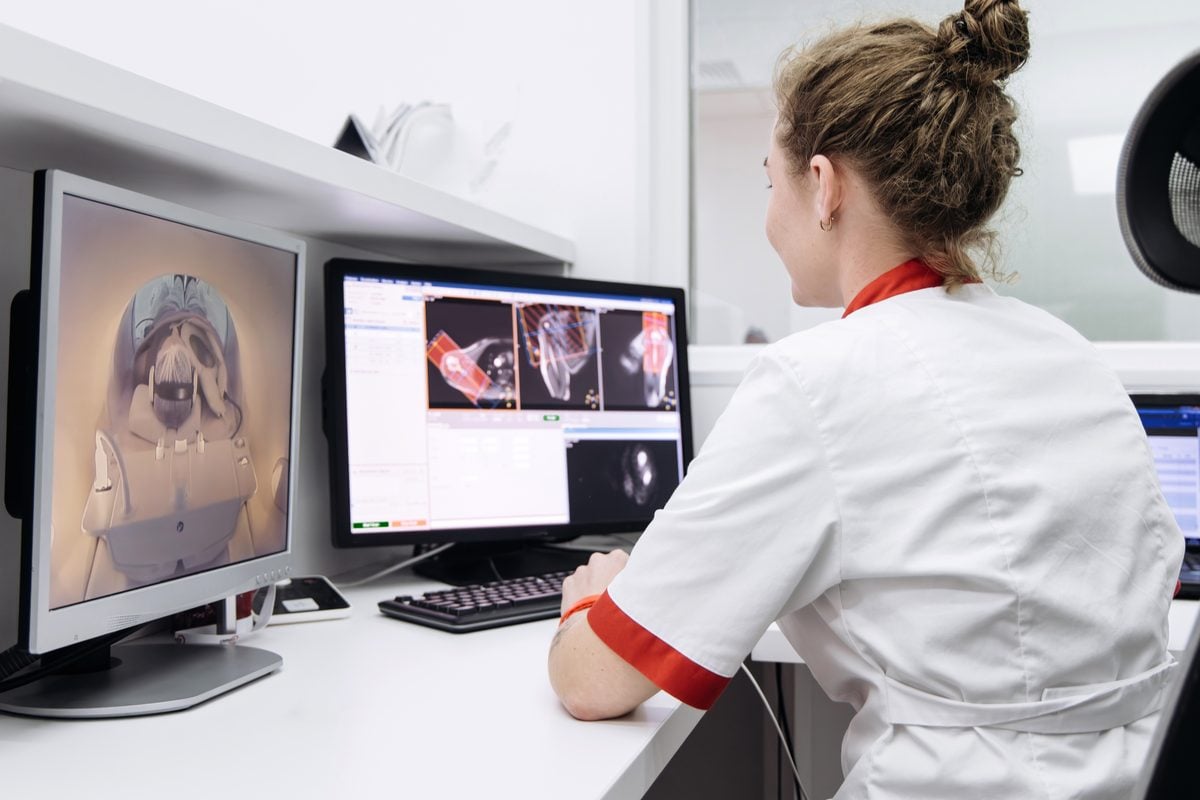
Whole-body MRI asks: what is physically there? It produces detailed images of your internal structures — brain, spine, chest, abdomen, pelvis — and our board-certified radiologists examine those images for anything that looks abnormal in size, shape, or texture. If there is a mass, MRI can often show where it is, how large it is, and what it appears to be made of.
One is looking for a chemical trace. The other is looking at anatomy. That distinction drives nearly everything else.
What a blood test can find
Multi-cancer blood tests are strongest where imaging has historically been weakest. Some cancers grow in places that are difficult to see and are rarely caught early — the pancreas, the ovaries, the esophagus, the stomach, the liver. These cancers often produce no symptoms until they are advanced, and there is no routine screening test for most of them.
MCED tests were designed with exactly this problem in mind, and the results are meaningful. In its development studies, Cancerguard reported 68% sensitivity across a group of six cancers with the lowest five-year survival rates, and manufacturer materials describe detection of signals associated with more than 50 cancer types. In GRAIL’s PATHFINDER 2 study of more than 35,000 participants, Galleri showed 69.8% sensitivity for the twelve cancers responsible for roughly two-thirds of cancer deaths in the United States, with specificity of 99.6%. We cover the newer of the two tests in detail in our guide to what the Cancerguard test is, and set the two side by side in our Cancerguard vs. Galleri breakdown.
There is real value there. A blood test can also detect signals from cancers of the blood and lymphatic system, which imaging is not well suited to finding at all.
What a blood test cannot find
Three limitations matter, and they are not fine print.
The most common cancers may be outside the test’s scope. Cancerguard’s own labeling states it is not indicated for breast or prostate cancer screening. Those are the two most frequently diagnosed cancers in the United States — the American Cancer Society projects 321,910 new breast cancer cases and 333,830 new prostate cancer cases in 2026, out of roughly 2,114,850 total diagnoses. That is about 31% of all new cancer diagnoses in the country falling outside what the test is designed to look for. This is not a criticism of the test; it is what the test is for. But a patient who believes they have been screened for cancer generally, and has not been told this, is working from a false picture. We walk through that gap, and what does cover those two cancers well, in the two most common cancers blood tests don’t screen for.
Early tumors may not shed enough to be seen. The signal these tests detect depends on tumor cells releasing material into the bloodstream, and the amount released tends to scale with how much tumor is present. A very small, very early tumor may not shed enough DNA to cross the detection threshold. This is why sensitivity for stage I disease has been consistently lower than for later stages across MCED studies. The biology creates a floor, and it sits precisely where early detection would be most useful. Our guide to how accurate the Cancerguard test is explains why a single accuracy percentage is never the whole story, and signal vs. anatomy covers what routine blood work can and cannot show.
A negative result is not an all-clear. No MCED test is accurate enough or broad enough that a negative result means cancer is absent. Both manufacturers state this directly, and the concern researchers raise most often is that a reassuring blood result may lead someone to skip a mammogram or postpone a colonoscopy. That would be a poor trade.
What whole-body MRI can find
MRI works differently. It uses a strong magnetic field and radio waves to produce images of soft tissue in remarkable detail, with no ionizing radiation and, in our protocols, no contrast dye. A specialized sequence called diffusion-weighted imaging is particularly useful here — it measures how water molecules move through tissue, and because tumor tissue is typically more densely packed than healthy tissue, it can make abnormalities stand out.
Because MRI looks at structure rather than signal, it does not depend on a tumor shedding anything. A mass large enough to see is a mass large enough to see. That makes MRI well suited to finding lesions in the kidneys, liver, brain, ovaries, spine and bone marrow — and it is the reason MRI is used for cancer surveillance in people with inherited cancer predisposition syndromes, where guidelines support it.
MRI also produces information a blood test structurally cannot: location, size, shape, and relationship to surrounding structures. If something is found, you are not starting an investigation. You are already partway through one.
What whole-body MRI cannot find
We are direct with patients about this, because a scan oversold is a scan that disappoints.
Whole-body MRI is poor at detecting small lung nodules — published sensitivity for indeterminate pulmonary nodules is around 23%, and low-dose CT remains the only lung screening test with demonstrated mortality benefit. It does not evaluate the lining of the colon, so it cannot substitute for a colonoscopy. It does not characterize thyroid nodules, which are assessed by ultrasound. And a whole-body protocol is not the same as a dedicated breast or prostate MRI — those require specific positioning and sequences that a survey scan does not include.
It is also important to be honest about yield. Across published studies of whole-body MRI in people without symptoms, confirmed cancer is found in roughly 1% to 2% of those scanned — a pooled rate of 1.57% across 9,024 participants in a 2025 European Radiology meta-analysis. Incidental findings — spots, cysts, nodules that turn out to be harmless — are common, and some of them lead to follow-up testing that ultimately finds nothing wrong. Anyone considering a scan deserves to know that before booking, not after.
Neither of these tests carries evidence that it extends life. That research does not yet exist for whole-body MRI screening or for any MCED test, and anyone who tells you otherwise is ahead of the data.
Where the two approaches meet
Here is the part that surprises most people. A positive blood test result is usually not an answer. It is the beginning of an imaging pathway.
In GRAIL’s PATHFINDER study, 92% of participants with a detected cancer signal went on to have at least one imaging test, and more than half had more than one. The most common was PET-CT, used in 61% of cases. And in that same study, 38% of positive results turned out to represent actual cancer — meaning 62% were false positives. The median time from positive result to a definitive answer was 79 days. For those whose result was ultimately a false alarm, it was 162 days.
That is a long time to wait, and RSNA’s journal Radiology has noted that there are not yet established clinical guidelines for how imaging should be used after a positive MCED result. The blood test can tell you something may be there. Something has to show you whether it is. If you have already had a positive result, we walk through that pathway in what happens after a positive cancer blood test.
This is why we think of these tools as sequential rather than competing. A blood test can raise a question. Imaging is how the question gets answered.
How to think about your own screening
If you are weighing these options, a few things are worth holding onto.
Start with the screening that has the strongest evidence behind it — mammography, colonoscopy, cervical screening, PSA discussion with your doctor, and low-dose CT if you have a smoking history. These have been studied for decades and none of the newer tools replace them.
From there, understand what each additional test adds. A multi-cancer blood test may extend coverage toward cancers that have no routine screening at all, particularly if you are over 50, since these tests are indicated for adults aged 50 and above. If you are younger, cancer blood tests before 50 covers what is actually available to you. Whole-body imaging offers something different — a structural look at your body and a personal baseline, available from age 18, that future scans can be compared against.
And if you have already taken a blood test and received a result you do not fully understand, that is a reasonable thing to bring to a conversation rather than carry alone.
Taking a proactive approach to your health starts with understanding what is actually happening inside your body — and with being clear-eyed about which questions each test can genuinely answer.
Frequently asked questions
What does a multi-cancer blood test actually detect?
A multi-cancer blood test can detect signals associated with many cancer types, and some tests predict where the signal originates. But no blood test covers every cancer. Cancerguard, for example, is not indicated for breast or prostate cancer screening, and no MCED test is accurate enough for a negative result to rule cancer out.
Is a whole-body MRI better than a cancer blood test?
They answer different questions rather than competing. A blood test looks for a chemical signal; MRI looks at physical structure. A blood test may point toward cancers with no routine screening; MRI can show location, size and shape. Neither replaces standard screening such as mammography or colonoscopy.
What happens if a cancer blood test comes back positive?
A positive result almost always leads to imaging. In the PATHFINDER study, 92% of people with a cancer signal had at least one imaging test, most commonly PET-CT. Because a majority of positive results in that study were false positives, the next step is confirming whether anything is physically present.
Are these tests FDA-approved?
No. Cancerguard and Galleri are both offered as laboratory-developed tests rather than FDA-approved products, and they are generally not covered by insurance. Whole-body MRI screening is likewise not covered by most plans.
Which cancers does an MRI have difficulty detecting?
MRI is limited for small lung nodules, does not evaluate the colon lining, and does not characterize thyroid nodules. A whole-body protocol is also not equivalent to a dedicated breast or prostate MRI. This is why imaging supplements guideline-based screening rather than replacing it.
Sources
- Cancer statistics, 2026 — CA: A Cancer Journal for Clinicians (American Cancer Society), 2026
- Cancerguard® Multi-Cancer Early Detection Test — Exact Sciences
- Frequently Asked Questions (FAQs) for Patients — GRAIL
- Frequently Asked Questions (FAQs) for Providers — GRAIL
- GRAIL Presents PATHFINDER 2 Results of More Than 35,000 Participants Showing the Galleri® Test Substantially Increased Cancer Detection With Robust Performance and Favorable Safety at 2026 ASCO Annual Meeting — GRAIL, 2026
- Blood-based tests for multicancer early detection (PATHFINDER): a prospective cohort study — The Lancet, 2023
- Multi-Cancer Early Detection Tests: State of the Art and Implications for Radiologists — Radiology (RSNA), 2025
- Whole-body MRI for opportunistic cancer detection in asymptomatic individuals: a systematic review and meta-analysis — European Radiology, 2026
- Questions and Answers about Multi-Cancer Detection Tests — National Cancer Institute (Division of Cancer Prevention)