Type “full body scan near me” into a search bar and you get back places that do genuinely different things: whole-body MRI centers, low-dose CT clinics, bone-density scanners, and directory pages that lump all three together. The nine questions below sort them out. They cover the machine, the radiologist, the report, the price, and what happens if the scan finds something. Every one of them has an answer a careful imaging center will give you over the phone, before you pay anything. At MRI Wellness in North Charleston we publish our own answers, and we would rather you ask them of us than book blind.
Why one search for a full body scan near me returns such different places
“Full body scan” is a marketing phrase, not a medical one. Some centers mean a low-dose CT, which uses X-rays and delivers a real dose of ionizing radiation. Some mean a whole-body MRI, which uses a strong magnet and radio waves and no radiation at all. Some mean a DEXA scan that measures bone density. A few of the results are directory listings rather than imaging centers. So before you compare prices, work out which technology you are pricing. We put the two main ones side by side in how MRI and CT compare for full-body screening.
Questions 1 to 3: the machine, and what it does to your body
1. Is this an MRI, a CT, or a combination of both? Ask plainly, and ask whether any part of the visit involves radiation. A whole-body MRI at MRI Wellness uses no ionizing radiation and no contrast dye at any point. If a center pairs MRI with CT, you are accepting a radiation dose in exchange for what the CT adds, and that is a trade-off worth understanding beforehand rather than afterward.
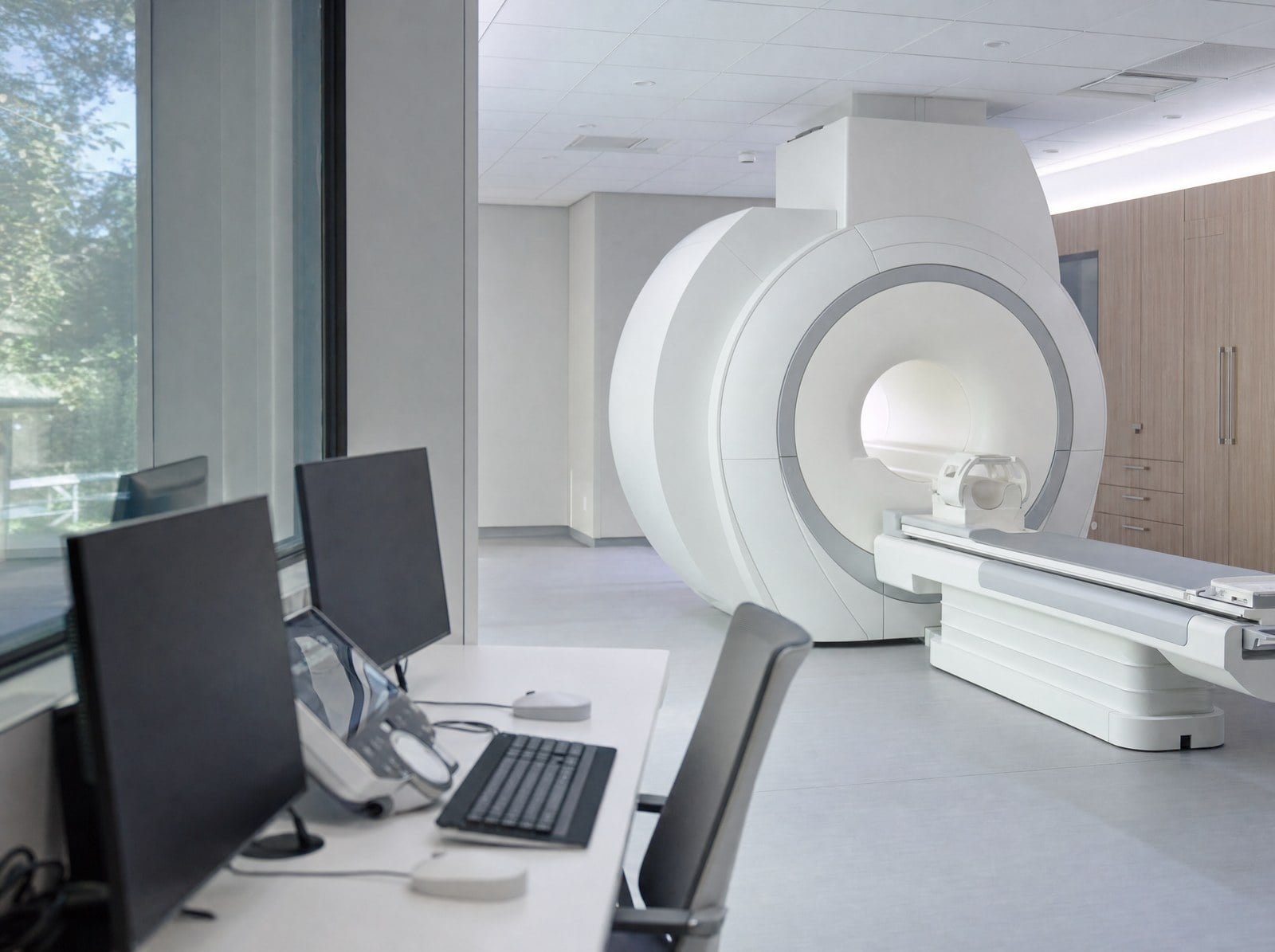
2. What is the scanner’s field strength, and how much of the body does one appointment cover? Field strength is measured in tesla, and 1.5T and 3T are the usual options. Stronger is not automatically better here: a 3T magnet deposits more energy in the body, which limits how many images can be captured in a single session. We screen on a 1.5T scanner for exactly that reason, and we explain the thinking in why 1.5T is preferred over 3T for whole-body screening.
3. Is the center accredited, and by whom? The American College of Radiology runs an accreditation program that sets image-quality standards for MRI facilities. Any center should be able to tell you where it stands on that without hesitating.
Questions 4 to 6: who reads your images, and what you get back
4. Who reads the images, and do they read whole-body studies routinely? A radiologist who mostly reads knees and shoulders is doing different work than one who reads head-to-pelvis screening studies all day. MRI Wellness was founded by healthcare professionals with a combined 75-plus years of experience, our radiologists are whole-body MRI screening specialists, and you can read our chief radiologist’s published credentials before you call.
5. How do results reach you, and how long do they take? There is a real difference between a PDF landing in your inbox and a person walking you through your own images. Every scan here includes a live results consultation, a 20 to 30 minute call or in-person review with a provider, and results are typically ready within 5 to 7 business days. Ask any center for both numbers: the turnaround, and whether a human being explains the report.
If the scan finds something
6. What happens next, and who tells you? A screening scan sometimes turns up something unrelated to the reason you came in. Ask who contacts you, how quickly, and what they hand you to take to your own doctor. A finding on a screening scan is information, not a diagnosis, and it needs a physician’s evaluation before anyone acts on it. We walk through that process in how incidental findings are handled. MRI Wellness does not make specialist referrals at this time, so plan on your own physician being the next stop.
Questions 7 and 8: price and eligibility
7. What is the total price, and what does it include? Look for flat prices published on the website rather than a quote produced after a phone screening. Ours are posted: $2,200 for the whole body, $1,800 for the torso, $950 for brain and spine, and $1,500 for the Fire Fighters Screening Scan, which concentrates on the brain, abdomen and pelvis for inhalation and environmental exposure. The scan is self-pay, FSA/HSA eligible, and needs no authorization step. We break the numbers down in what a full body scan costs in South Carolina.
8. Am I eligible, and what would rule me out? Our scanner accommodates patients up to 350 pounds, and we screen adults 18 and older. The U.S. Food and Drug Administration notes in its MRI safety guidance that some implants, including certain pacemakers, and metal fragments in the body can make a scan unsafe or require special handling. MRI is avoided during pregnancy. And if enclosed spaces worry you, say so when you book rather than once you are on the table; it is a common concern and worth talking through in advance.
Question 9: what a full body scan will not do
9. What are the limits of this scan? The answer to this one tells you the most about a center. A whole-body MRI does not replace a mammogram, a colonoscopy, a Pap smear, or any targeted study your physician has ordered. There are also no evidence-based guidelines calling for whole-body MRI screening across the general population. The U.S. Preventive Services Task Force publishes graded recommendations for specific screenings, such as breast, colorectal and lung cancer, and whole-body imaging of people without symptoms is not among them. A center willing to say that out loud is being straight with you. Our full body scan decision guide lays out who has a reason to look and what the images can and cannot show.
Asking the nine questions here in Charleston
MRI Wellness is at 2683 Elms Plantation Blvd in North Charleston, and no referral is needed to book a whole-body screening scan. Most people who sit down with us arrive with a reason to look: cancer in the family, a known genetic risk, or a symptom nobody has explained yet. That is a different starting point than scanning because a search result suggested it, and it is still a personal decision, one worth making with your primary care provider before you spend the money. If you want the local picture first, start with full-body MRI in Charleston, then take these nine questions to whichever center you are weighing, including ours. Early detection from the Holy City works best when you know exactly what you are buying.
Frequently asked questions
How much does it cost to have a full body scan?
Prices vary widely by center and by technology, so compare like with like. At MRI Wellness the prices are published: $2,200 for the whole body, $1,800 for the torso, $950 for brain and spine, and $1,500 for the Fire Fighters Screening Scan. The scan is self-pay and FSA/HSA eligible, with no referral and no authorization step in front of it.
Where can I get a full body scan near Charleston?
MRI Wellness screens at 2683 Elms Plantation Blvd in North Charleston. Its service areas include Summerville, James Island and the wider Charleston area, along with Greenville, Rock Hill, Spartanburg, Wilmington and Atlanta. No referral is needed to book a whole-body screening scan.
Is there a full body scan that can detect everything?
No. A whole-body MRI covers a lot of ground in one visit, but no single scan finds every condition. It does not replace a mammogram, a colonoscopy, a Pap smear, or a targeted study your physician has ordered, and anything it does show needs a physician’s evaluation before it means anything. That is worth asking about directly when you compare centers.
Is a full body scan worth it?
That depends on why you are considering one. People who come to us usually have a specific reason to look: a family history of cancer, a known genetic risk, or symptoms nobody has explained. Whole-body MRI is not guideline-backed screening for the general population, so it is a personal decision, and a good one to talk through with your primary care provider first.
Do I need a referral for a whole-body MRI screening scan?
No referral is needed at MRI Wellness, and there is no insurance authorization step. You do still review your results in a live consultation with a provider rather than just receiving a report, and any finding goes to your own physician for evaluation.