MRI and CT are two of the most important imaging tools in modern medicine, and patients often ask which one is better for a full-body screening. The honest answer is that they are designed for different jobs. Both produce detailed images of the inside of the body, but they use very different technology, carry very different risks, and excel at very different things.
Understanding how they compare helps explain why whole-body MRI has become the standard for preventative screening — and why CT continues to play an important role in specific clinical situations. This article walks through how each technology works, where they differ, and why MRI Wellness uses MRI as the foundation of proactive imaging.
MRI vs CT Scan: How Each One Works
CT, or computed tomography, uses X-rays. A rotating X-ray source captures cross-sectional images of the body, which a computer reconstructs into a 3D view. CT is fast — most scans take just a few minutes — and it is excellent at showing dense structures like bone and acute findings like internal bleeding or kidney stones.
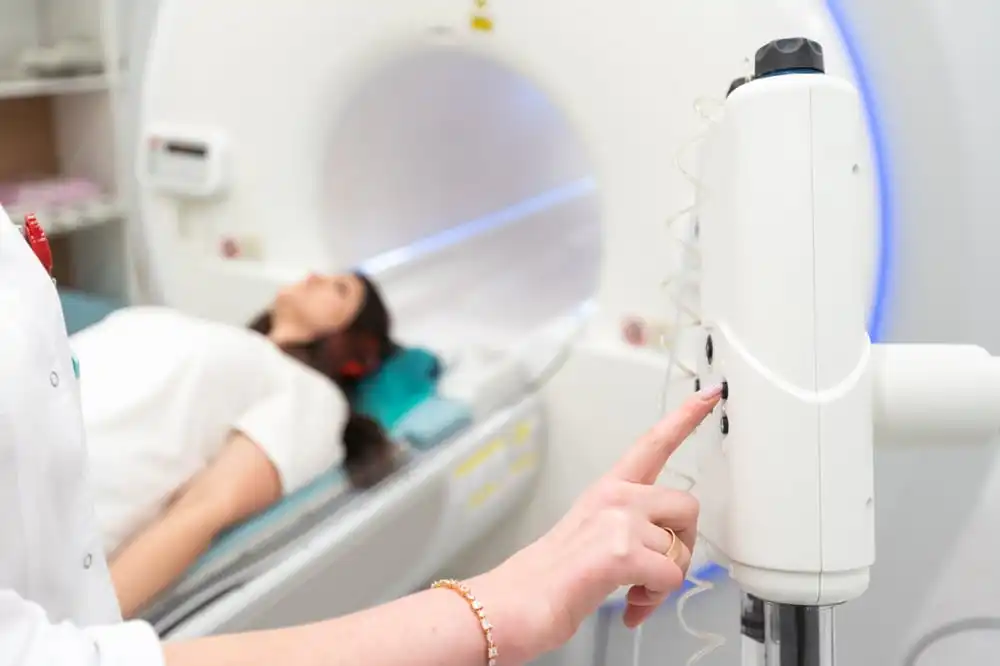
MRI, or magnetic resonance imaging, uses a powerful magnetic field and radio waves to align and then read the behavior of water molecules in your tissues. The result is a highly detailed image of soft tissue, organs, blood vessels, and the nervous system. MRI takes longer than CT, but it produces a level of soft-tissue detail that CT cannot match. We walk through the physics and patient experience in more detail in our piece on the technology behind whole-body imaging.
Radiation Exposure: A Key Difference
This is one of the most important distinctions between the two technologies. CT scans use ionizing radiation. A single full-body CT delivers a dose roughly equivalent to several hundred chest X-rays. For one-time diagnostic use, this is generally safe and clinically justified. For repeated screening over many years, the cumulative dose becomes a meaningful consideration.
MRI uses no ionizing radiation at all. That is a major reason it is preferred for preventative use. A patient who chooses to scan every one to three years can do so safely with MRI, because there is no cumulative radiation exposure to weigh against the benefit of early detection.
Contrast and Soft Tissue Detail
Both MRI and CT can be performed with or without contrast agents. CT contrast is iodine-based and is typically delivered through an IV. It carries a small risk of allergic reaction and can affect kidney function in some patients. MRI contrast is gadolinium-based and is also delivered through an IV, with different safety considerations.
At MRI Wellness, our standard preventative scan is performed without contrast. The protocol is designed to provide excellent visibility across organ systems while keeping the scan non-invasive and accessible to a broader range of patients. For more on what the visit itself looks like, see our what to expect during an MRI guide. For soft-tissue detail — brain, liver, kidneys, prostate, pelvic organs, joints, spine — MRI typically outperforms CT, which is one of the main reasons whole-body MRI has emerged as the preferred preventative tool.
When CT Is Preferred
CT remains the right tool in many clinical situations. In emergency medicine, CT’s speed and ability to evaluate trauma make it indispensable. It is also preferred for evaluating acute lung disease, kidney stones, and certain bone fractures. Low-dose CT is the recommended annual screening study for current and former heavy smokers at high risk of lung cancer.
These are diagnostic uses with clear clinical justification. Preventative whole-body screening is a different question. For a patient with no specific symptoms who wants visibility into many organ systems over the long term, the combination of soft-tissue detail and zero ionizing radiation makes MRI the more appropriate choice.
Why We Use Whole-Body MRI for Preventative Screening
Whole-body MRI is increasingly used in academic centers, executive health programs, and dedicated preventative clinics because it answers the central question of preventative care: “What is happening inside this body right now, and is anything changing in a way I should pay attention to?” It does this safely, repeatedly, and across many organ systems in a single visit. Our article on why we use 1.5T MRI rather than 3.0T explains how the field strength itself was selected with preventative screening in mind.
MRI Wellness was built around exactly this idea. Our protocol is designed to balance comprehensive visibility with patient comfort, with one of our board-certified radiologists reviewing every study. For patients who want to take a proactive approach to their health without accepting cumulative radiation exposure, whole-body MRI is the most appropriate tool available today.
Frequently asked questions
Is MRI better than CT for full-body screening?
For preventative screening in patients without symptoms, MRI is generally preferred because it uses no ionizing radiation and offers superior soft-tissue detail. CT remains the right tool for many diagnostic situations.
Does a full-body MRI use radiation?
No. MRI uses magnetic fields and radio waves rather than ionizing radiation. That makes it well-suited for repeated preventative use.
Why do hospitals still use CT scans so often?
CT is fast, widely available, and excellent at evaluating bone, acute injury, and certain lung and kidney findings. It is a different tool used for different clinical questions.
Is contrast safer for MRI or CT?
Both contrast agents are well-studied and generally safe for appropriate patients. CT contrast can affect kidney function; MRI contrast has different considerations. Many preventative MRIs, including those at MRI Wellness, are performed without contrast.
Can MRI find everything that a CT can find?
Not always. CT is better for certain bone fractures, lung nodules, and acute bleeding. MRI is better for most soft-tissue evaluation. The technologies are complementary rather than competitive.
Sources
- What are the Radiation Risks from CT? — U.S. Food and Drug Administration
- Body CT — RadiologyInfo.org (RSNA/ACR)
- ACR Appropriateness Criteria — American College of Radiology
- Computed Tomography (CT) Scans and Cancer Fact Sheet — National Cancer Institute
- Radiation dose associated with common computed tomography examinations and the associated lifetime attributable risk of cancer — Archives of Internal Medicine, 2009