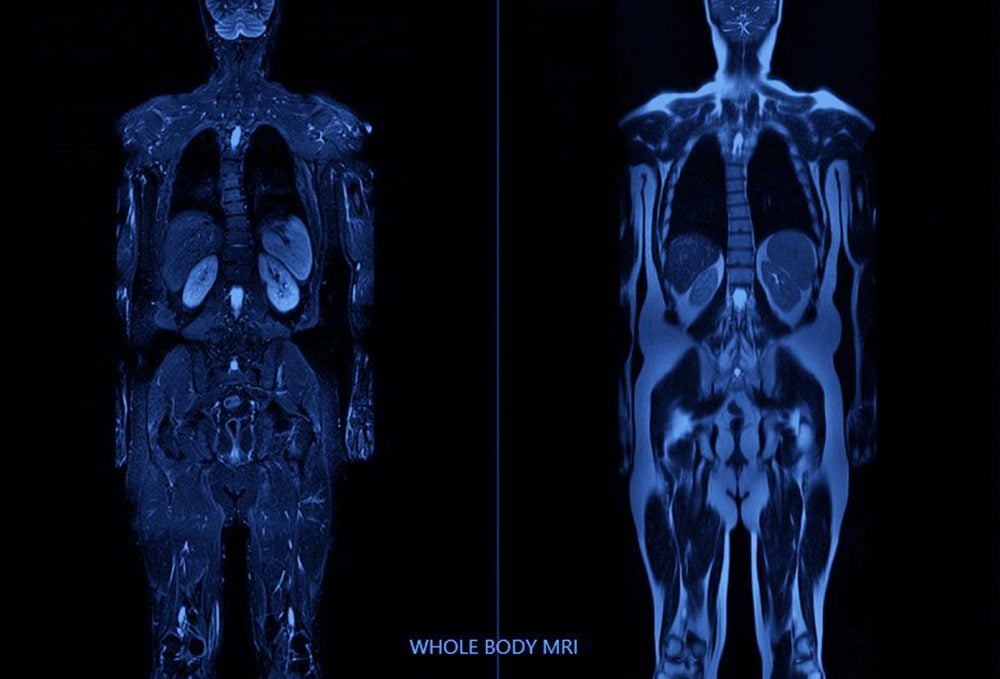
If you are weighing a preventive scan, one of the most natural questions to ask is simple: what can a full-body MRI detect? The honest, useful answer is that a whole-body MRI can survey a remarkable amount of your anatomy in a single session, from the brain down through the pelvis, and can surface many changes in the soft tissues and organs before symptoms ever appear. It is a screening tool, not a diagnosis, and it has real limits worth understanding. This head-to-toe guide walks through what the scan looks at, what it tends to find, and where other tests do a better job.
A full-body MRI uses a strong magnetic field and radio waves to create detailed images of the body’s soft tissues. Because it relies on magnetism rather than X-rays, there is no ionizing radiation, and the standard Whole Body Scan uses no contrast dye. That combination makes it well suited to imaging organs and soft tissue over and over across a lifetime. For a plain-language definition first: a full-body MRI is a preventive imaging check-in that photographs your major organs and structures in one appointment, giving you and your doctor a baseline to keep and compare against over time.
The Brain and Head
At the top of the scan, MRI is genuinely strong. It is the imaging test doctors reach for when they want a detailed look at the brain, because it renders soft tissue with high contrast and clarity. A preventive brain MRI can surface structural findings such as an aneurysm (a weak, ballooning spot in a blood vessel wall), a benign tumor like a meningioma, a pituitary lesion, or signs of prior small strokes. It can also show the general size and symmetry of brain structures. What it does not do is read brain function or diagnose conditions like migraine or most psychiatric concerns, which are clinical rather than structural. Anything the scan flags is a starting point for a conversation with your doctor, not a verdict.
The Spine and Neck
Moving down, MRI is the standard for imaging the spinal cord and the discs and nerves around it. A whole-body scan can show disc degeneration, herniations, narrowing of the spinal canal, and, less commonly, tumors or lesions along the spine. Because so many people carry painless, age-related spine changes, this is a good place to remember that a finding is not the same as a problem; the value is in seeing the whole picture and letting a clinician decide what, if anything, matters for you.
The Chest, Heart, and Lungs
The chest is where the honest limits of MRI come into focus. MRI can image the heart’s chambers and large blood vessels, and it can pick up an enlarged aorta or gross structural changes. It is less suited, however, to the fine detail of the lungs. Air-filled tissue and small, subtle lung nodules are seen far better on a CT scan, which is why low-dose CT — not MRI — is the recommended tool for lung cancer screening in eligible current and former smokers. A whole-body MRI is not a substitute for that. It is best thought of as a broad survey of the chest’s soft-tissue structures, with the understanding that the lungs are the one region where another test leads.
The Abdomen: Liver, Kidneys, Pancreas, Spleen, and Adrenal Glands
The abdomen is where full-body MRI often earns its keep, because so many abdominal organs are solid and rich in soft tissue — exactly what MRI images well. A scan can survey the liver, kidneys, pancreas, spleen, and adrenal glands in one pass. Common findings include simple cysts, benign masses such as hemangiomas, kidney stones or growths, and fatty change in the liver. That last one matters more than many people expect: nonalcoholic fatty liver disease (NAFLD) is very common and often silent, and MRI can help show fat accumulation in the liver that would otherwise go unnoticed. As always, the scan describes what it sees; your physician interprets what it means for your health.
A Note on Hollow Organs
There is an important caveat in the abdomen. MRI is excellent for solid organs but is not the right tool for evaluating hollow organs like the stomach, small bowel, and colon in a screening setting. A whole-body MRI does not replace a colonoscopy for colon cancer screening, and it is not designed to inspect the lining of the digestive tract. If you are due for age-appropriate colon screening, that remains its own conversation with your doctor.
The Pelvis
In the pelvis, MRI can image the bladder and the reproductive organs, and it can surface findings such as ovarian cysts, uterine fibroids, or prostate changes. These are among the more common incidental findings on a preventive scan, and the large majority are benign. Because the pelvis contains structures that vary a great deal from person to person, it is a region where an experienced human read is especially valuable in separating the routine from the meaningful.
Soft Tissue, Muscles, and Lymph Nodes
Beyond the named organs, a whole-body MRI also surveys the soft tissues, muscles, and lymph nodes throughout the body. It can show enlarged lymph nodes, soft-tissue masses, and some musculoskeletal changes. This broad soft-tissue coverage is one of the quiet strengths of whole-body imaging, since it looks in places that no single targeted test would routinely include. For a fuller catalog of what the scan surveys, our overview of what conditions a whole-body scan can detect goes region by region in more detail.
Where a Full-Body MRI Falls Short
Being clear about limits is part of using any screening tool well. A full-body MRI is not ideal for the fine detail of bone, where CT gives sharper images of the cortex and small fractures. It is not the tool for detailed lung imaging or for evaluating hollow organs, as noted above. It does not detect every cancer, and it cannot rule disease in or out on its own. Perhaps most importantly, a full-body MRI is a screening survey, not a diagnosis; the images are read by a physician, and any finding that warrants attention is followed up with targeted testing. According to the Radiological Society of North America, body MRI is prized for detailed, radiation-free soft-tissue imaging — which describes both its strength and the boundaries of what it is designed to do.
What Findings Actually Look Like in Practice
It helps to set calm expectations about results. Roughly one in twenty scans finds something worth following up on, and the large majority of those findings are minor or benign — a small cyst, a benign nodule, an age-related change. These are called incidental findings: things the scan notices that were not the reason you came in. They are common and usually reassuring rather than alarming, but they do sometimes lead to a follow-up conversation or a targeted test. If you would like to understand this part of the process before you book, our guide to what incidental findings on an MRI are explains how they are handled and why most turn out to be nothing to worry about.
A Calm Way to Get a Baseline
Taken together, a whole-body MRI offers a broad, radiation-free look at your major organs and soft tissues in a single, comfortable appointment. It is at its best as a baseline: a clear reference point you can keep, so any future change can be seen in context. At MRI Wellness, every scan is reviewed personally by Dr. Edward Tavel, our Medical Director, and you receive a written report in plain language along with the chance to talk it through. If a preventive baseline sounds like the right next step for you, our Whole Body Scan in the Charleston area is designed to give you a thorough, reassuring snapshot and genuine peace of mind. There is no referral required, and the team is glad to answer your questions before you decide.
Frequently asked questions
What can a full-body MRI detect?
A full-body MRI can survey the brain, spine, chest, abdomen, and pelvis, along with soft tissues, muscles, and lymph nodes. It can surface findings such as aneurysms, benign tumors, cysts, fatty liver, kidney and organ changes, fibroids, and enlarged lymph nodes. It is a screening tool that produces a baseline, not a diagnosis.
What can a full-body MRI not detect well?
MRI is not ideal for the fine detail of the lungs or bone, where CT performs better, and it is not designed to evaluate hollow organs like the colon and stomach in a screening setting. It does not replace low-dose CT lung screening or a colonoscopy, and it cannot detect every condition.
Can a full-body MRI detect cancer?
A whole-body MRI can reveal masses and structural changes that may warrant further evaluation, and it images many organs where tumors can arise. It does not detect every cancer and cannot confirm a diagnosis on its own; any concerning finding is followed up with targeted testing interpreted by your physician.
Is a full-body MRI safe?
Yes. MRI uses a magnetic field and radio waves, so there is no ionizing radiation, and the standard Whole Body Scan uses no contrast dye. A brief safety questionnaire is reviewed before the scan to check for certain implanted devices and other contraindications.
What happens if the scan finds something?
Roughly one in twenty scans finds something worth following up on, and most of those findings are minor or benign. Dr. Edward Tavel, our Medical Director, reviews every scan and provides a written report in plain language. If a finding warrants attention, you and your doctor decide on any next steps together.
Do I need a referral for a full-body MRI?
No. You can schedule a preventive scan directly without a referral. Many patients choose to share the written report with their primary-care physician afterward so it becomes part of their ongoing care.
Sources
- Body MRI — RadiologyInfo.org (RSNA/ACR), 2026
- MRI — Mayo Clinic, 2023
- ACR Statement on Screening Total Body MRI — American College of Radiology
- Cancer Screening Overview (PDQ®)–Patient Version — National Cancer Institute, 2023
- MRI (Magnetic Resonance Imaging) — U.S. Food and Drug Administration, 2018