If you typed “open MRI near me” into a search bar, you are probably asking two things at once: where can I get scanned, and can I lie inside the machine long enough to finish? Those are different questions. An open scanner solves a comfort problem; a whole-body screening scan solves an information problem. At MRI Wellness in North Charleston, we would rather explain the difference than let a machine’s shape decide what you learn about your health.
Three different machines, one search phrase
Imaging centers run one of three basic designs, and people tend to use the word “open” for anything that is not the narrow tube they remember from years ago.
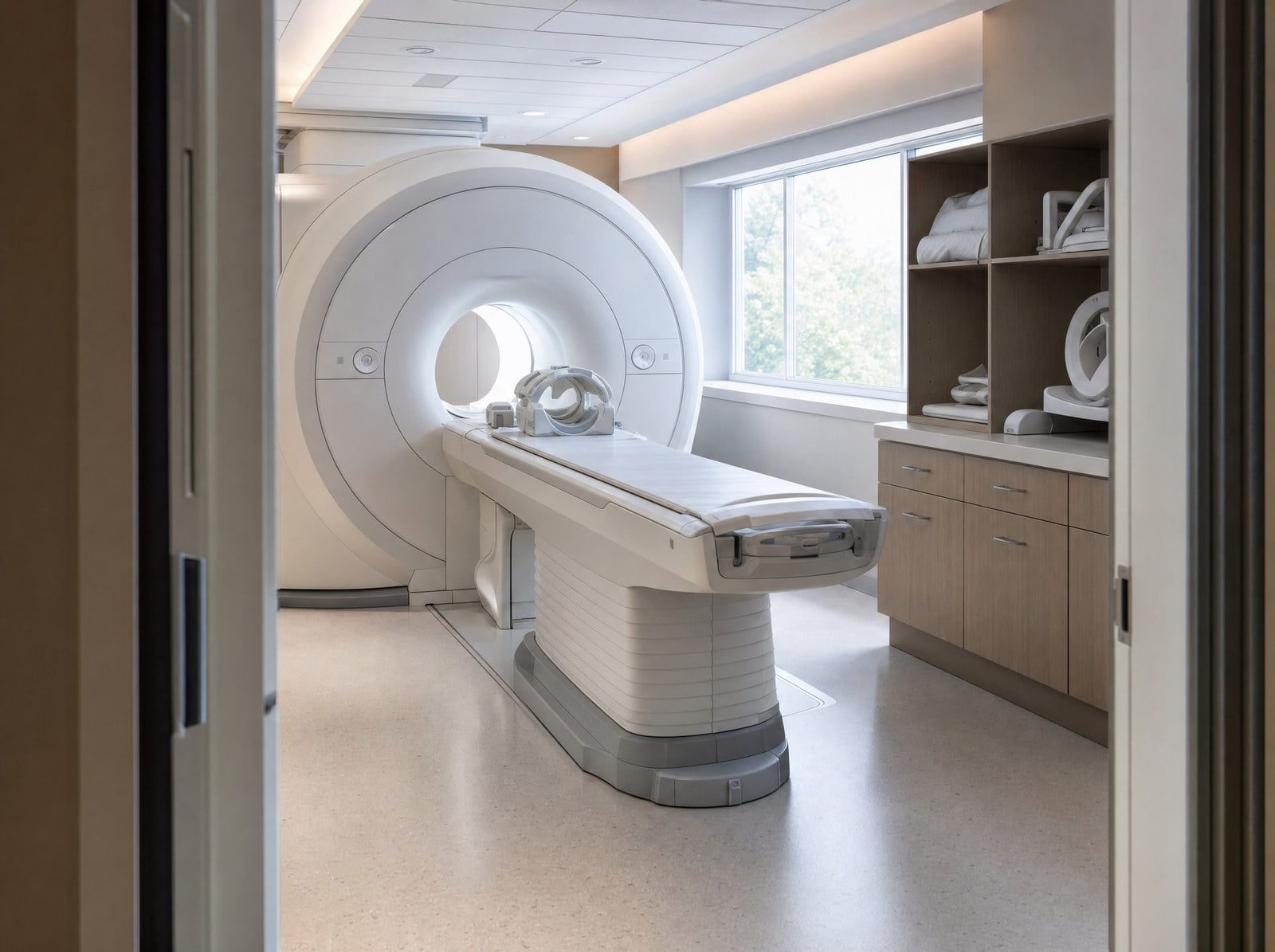
- Conventional closed-bore. A cylinder that surrounds you, usually 1.5 tesla (1.5T) or 3 tesla. Tesla is the unit of magnet strength, and a stronger magnet produces a stronger signal, which is what image detail is made of.
- Wide-bore. Still a cylinder, but with a wider opening, commonly around 70 centimeters across rather than roughly 60. The extra width helps many people who dread the narrow version.
- True open MRI. The magnet sits above and below you and the sides stay open, so you can see the room. These units generally run at lower field strengths, often well under 1 tesla.
Ask a center which of the three they run. The answer changes what your scan can show.
Is an open MRI as good as a closed-bore MRI?
For the job it was built for, often yes. A lower-field open unit can answer a single, well-defined question — a knee, a shoulder, a lumbar spine — and a scan you can finish is worth more than a higher-field scan you call off from the table.
The trade-off is signal. A weaker magnet gives the scanner less to work with, so it compensates either by scanning longer or by accepting coarser detail. On one joint that is usually manageable. Across a whole body of soft tissue, where the point is to notice something small and early, the gap compounds region by region.
Field strength is not the only variable. Coil design, the sequences chosen and the radiologist reading the images all move the result. The American College of Radiology accredits MRI facilities against image-quality standards, and any center you call should be able to say where it stands.
Why our whole-body screening runs on 1.5T
MRI Wellness screens on a 1.5T scanner by deliberate choice, not by default. A 3T magnet deposits more energy in the body and raises tissue temperature faster, which limits how much of you can be imaged in one session. For head-to-pelvis coverage in a single visit, 1.5T is the more practical magnet, and we lay out the reasoning in why 1.5T is preferred over 3T for whole-body screening.
A few specifics worth having in hand when you compare centers: the scan uses no ionizing radiation and no contrast dye at any point, the scanner accommodates patients up to 350 pounds, and we screen adults 18 and older. For a realistic sense of how the appointment runs, how long a full-body MRI actually takes walks through it from check-in to finish.
When the enclosed space is the real worry
Claustrophobia is one of the most common reasons people go hunting for an open scanner, and there is nothing embarrassing about it. Most of the dread is uncertainty, which is the part you can do something about.
- Say something when you book, not when you are already on the table. It changes how the team runs your appointment.
- Ask what the room looks like, how far into the scanner you will go, and what you will hear. The knocking is loud, and it is completely normal.
- Slow, steady breathing with your eyes closed before you move in works for more people than you would guess.
- If your anxiety is severe, raise it with your primary care provider ahead of time so you can plan the visit together.
Safety screening comes first whatever the machine. The U.S. Food and Drug Administration’s MRI guidance notes that some implanted devices, including certain pacemakers, and retained metal fragments can make a scan unsafe or require special handling. MRI is also avoided during pregnancy. Expect questions about all of it before you are cleared.
Match the machine to the question you are asking
A specific concern a physician wants imaged
Follow the order your doctor wrote. A targeted study answers a targeted question, and an open unit may be a perfectly good place to have it done. A whole-body screening scan does not replace a mammogram, a colonoscopy, a Pap smear or any study your physician ordered, and we will never suggest otherwise.
A baseline, because you have a reason to look
Cancer in the family, a known genetic risk, or symptoms nobody has explained — that describes most of the people who come to us. A broad look at the body in one sitting is what a whole-body MRI is built for, and it needs the detail a high-field magnet provides. Screening is still a personal decision, and a good one to make with your primary care provider. No major body, the U.S. Preventive Services Task Force included, publishes a screening guideline calling for whole-body MRI in the general population.
If something does turn up, treat it as information rather than an answer. Any finding has to be evaluated by a physician who knows your history before it means anything. What conditions a whole-body scan can detect covers the range candidly, how incidental findings are handled explains what follows one, and if you are still weighing the decision itself, start with our full body scan decision guide.
What to ask before you book anywhere
Wherever you end up going, four questions separate a solid answer from a vague one:
- What field strength is the scanner, and is it open, wide-bore or conventional?
- Is the facility accredited for MRI, and by whom?
- Who reads the images, and how much whole-body work do they do?
- What is the total price in writing, and what does it include?
We go further on this in nine questions to ask before you book a full body scan.
Getting scanned near Charleston
MRI Wellness sits at 2683 Elms Plantation Blvd in North Charleston. No referral is needed, prices are published up front — $2,200 for the whole body, $950 for brain and spine — and the scan is self-pay and FSA/HSA eligible. Results typically come back within 5 to 7 business days, and you go through them in a 20 to 30 minute live consultation with a provider instead of a report you read alone. If you want the local picture first, we wrote about full-body MRI in Charleston.
If a true open unit is what your situation calls for, go find one; that is a good outcome. If what you want is a careful, radiation-free look at the whole body because something in your history gives you a reason to look, that is the work we do. Early detection from the Holy City starts with picking the scan that answers your question.
Frequently asked questions
Can you request an open MRI?
You can ask, but the center has to have one. Most facilities run closed-bore or wide-bore scanners and true open units are less common, so call and ask which design they operate rather than assuming. If your physician ordered a specific study, check with that office too, since the scanner type can affect how readable the images are for the question being asked.
Is open MRI as good as closed?
It depends on the question. Open scanners usually run at lower field strength, which means less signal and either longer scan times or coarser detail. For one joint or one region, that is frequently fine. For screening the whole body, where the goal is to pick up something small, the higher detail of a 1.5T system matters more.
Can I get an MRI if I am claustrophobic?
Many people who expect not to manage it do fine once they know what to expect. Tell the team when you schedule, ask how far into the scanner you go and what you will hear, and try slow breathing with your eyes closed before you move in. If your anxiety is severe, talk it through with your primary care provider in advance so the visit can be planned around it.
Where can I get an open MRI scan near Charleston?
We do not keep a directory of other facilities, so the reliable move is to call imaging centers in the area and ask directly whether their scanner is open, wide-bore or conventional. MRI Wellness screens on a 1.5T system in North Charleston, takes patients 18 and older, and does not require a referral.
Does a whole-body MRI tell me whether I have cancer?
No. A screening scan produces images, not a verdict. A radiologist describes what the images show, and anything of concern has to be evaluated by a physician who knows your history and can decide whether further testing makes sense. At MRI Wellness you review your results in a live consultation rather than receiving a report with no explanation.