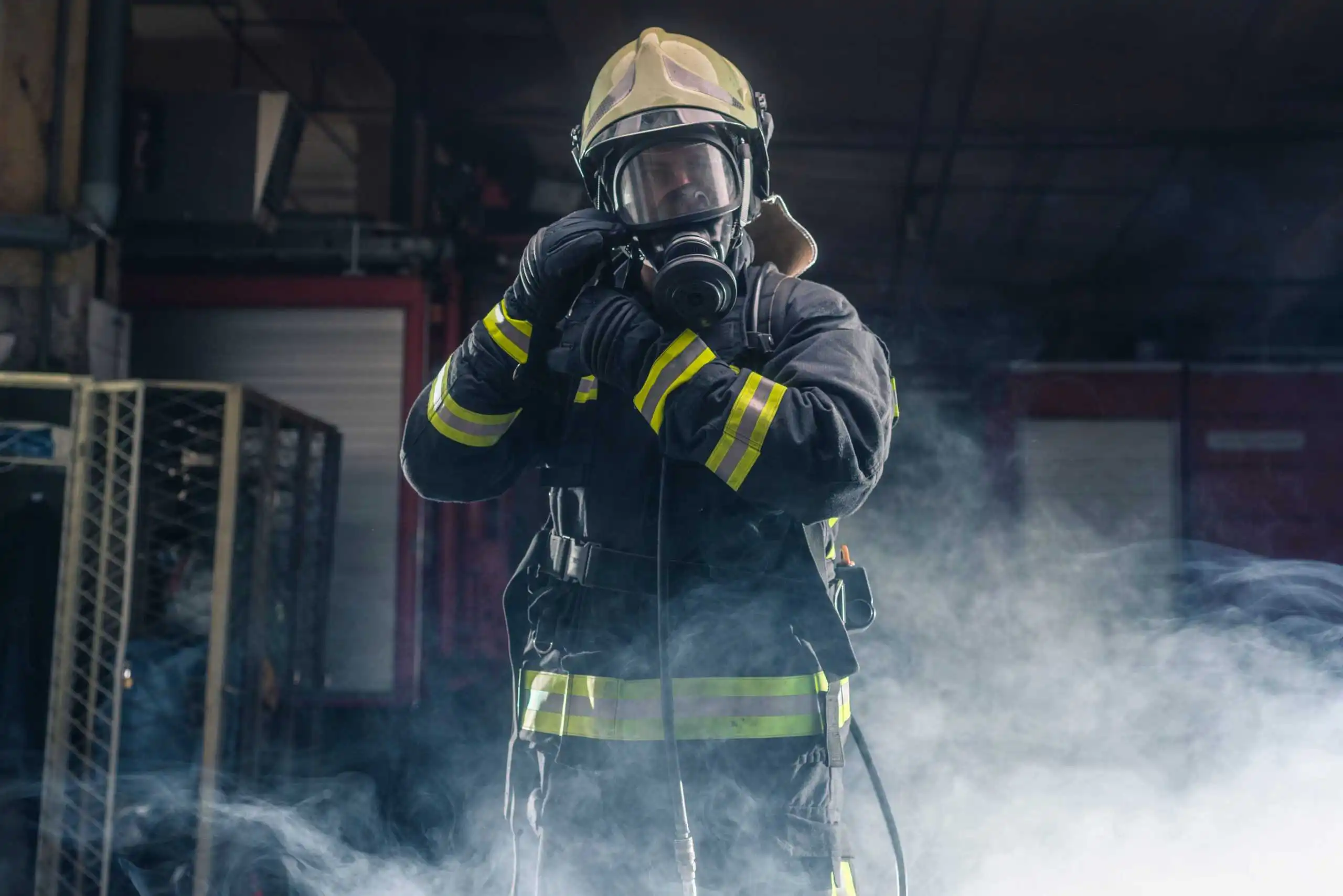
Every day, firefighters put their lives on the line to protect and save others within their communities. While we may believe the largest danger firefighters face is the flames they seek to extinguish, the greatest threat to their health and well-being lies in what comes after.
Occupational cancer is now the leading cause of line-of-duty death in the fire service. The International Association of Fire Fighters reports that 79.4 percent of the members honoured at its Fallen Fire Fighter Memorial in September 2025, 247 of 311, died of occupational cancer.
Firefighters are at an increased risk of developing cancer through their line of work due to the smoke and hazardous chemicals they are exposed to in the line of duty.
January represents not only the start of a new year but also seeks to raise awareness for the risk of cancer in firefighters. Keep reading as we break down firefighter’s risk of developing cancer and how a whole-body MRI scan may be the answer in the prevention and early detection of cancer.
Firefighters and Cancer Risk
NIOSH studied nearly 30,000 career firefighters from Chicago, Philadelphia and San Francisco employed at any time between 1950 and 2009. Compared with the numbers expected using U.S. population rates, they had a 9 percent increase in cancer diagnoses and a 14 percent increase in cancer deaths. NIOSH describes this as a modest increase and has publicly cautioned against overstating it. The increase is real, and it concentrates in digestive, respiratory, urinary and oral cancers.
But the question is, why?
In this day and age, modern homes and buildings are made up of synthetic and plastic materials that, when burned, release various carcinogens into the air, including polycyclic aromatic hydrocarbons, a group of more than 100 chemicals that can cause cancer.
Carcinogens are substances that can alter the cells’ DNA, causing cancer. Carcinogens are not only found in building materials but can also be found in the following:
- Ultraviolet radiation (sunlight)
- Asbestos
- Processed meats
- Radon
- Lead
- Formaldehyde
Despite the use of protective outerwear worn by firefighters, along with self-contained breathing apparatuses (SCBA), toxic chemicals can still penetrate the gear and expose the skin to toxins.
Cancer Prevention in Action: How a Full Body MRI Scan Can Help
Full-body MRI scans are a relatively new technological advancement in healthcare. This powerful imaging test is used to detect abnormalities within the body, creating highly detailed images offering a closer look at your soft tissues, organs, bones, joints, and even blood vessels.
With the ability to screen over 13 organ systems and detect nearly 500 disease processes and conditions, a full-body MRI scan leverages technology to identify highly treatable diseases before they become a problem.
Stage at diagnosis drives outcome more than almost anything else. Colorectal cancer is a clear example, and it is one of the cancers IARC linked to firefighting: only about 35 percent of cases are caught while still confined to the bowel, while roughly 36 percent have reached regional lymph nodes and about 23 percent have spread to distant organs by the time they are found. Five-year relative survival falls from 91.1 percent for localised disease to 15.7 percent once it is distant.
What Firefighters Should Actually Do
We sell scans, so you would expect this section to point at one. It does not, or at least not first. Here is the honest order of operations.
1. Get the NFPA 1582 annual occupational medical evaluation. Not a generic physical. The U.S. Fire Administration’s 2024 firefighter cancer workgroup explicitly recommends departments provide annual exams to this standard. It is the exam that should include the screenings below. If your department is not providing it, that is a fixable problem your Local can raise. And tell whoever examines you that you are a firefighter and that IARC classifies your occupational exposure as a Group 1 carcinogen. Most primary care providers do not know this.
2. Decon, every time. This is the only step that lowers your risk of developing cancer rather than changing when you find out. SCBA through overhaul, gross decon on scene, wipe exposed skin especially neck and face, bag gear and keep it out of the cab, shower and change before you go home, extractor-wash hoods and gloves after every fire, keep PPE out of living quarters. Research on field decon has found soap, water and scrubbing removes substantially more polycyclic aromatic hydrocarbon contamination from turnout gear than dry-brushing alone. Dry-brushing by itself is not enough.
3. Do the screenings with mortality evidence behind them. The IAFF Wellness-Fitness Initiative recommends discussing colorectal screening from age 40, earlier than the general population guidance of 45. Annual skin inspection of sun-exposed areas, because melanoma is among the cancers associated with firefighting and no scan examines skin. A urine dipstick for blood at your wellness exam, because bladder cancer is one of only two cancers IARC found a causal relationship for, and the screening test costs almost nothing. A PSA discussion from 50, or 40 if you are at increased risk. Testicular self-examination. Regular dental checkups that include the whole mouth.
4. Check your lung screening eligibility honestly. Low-dose CT is recommended for adults 50 to 80 with a 20 pack-year smoking history who currently smoke or quit within 15 years. Occupational smoke exposure does not count toward pack-years, so a never-smoker with twenty-five years of structural fires is not eligible, and there is no approved alternative lung screening pathway for that person. The USFA workgroup states plainly that existing screening recommendations do not account for firefighting as a risk factor, and has recommended developing firefighter-specific guidance. That work is not finished.
So Where Does a Whole-Body MRI Fit?
Let us be precise, because this is where a clinic like ours is tempted to overreach.
A scan will not make you less likely to get cancer. Nothing about imaging can. Exposure reduction lowers risk. Screening changes when a cancer is found. Those are different things and we are not going to blur them.
The American College of Radiology holds that there is not sufficient evidence to justify recommending total body screening for people with no symptoms, risk factors or relevant family history, and notes it produces non-specific findings leading to unnecessary follow-up. Worth knowing: a firefighter is arguably not the person that statement describes, given a Group 1 occupational exposure and federal acknowledgement that current screening guidance does not account for it. That is an argument for discussing it with an occupational physician. It is not evidence the scan extends life, because that evidence does not exist for any population.
Be clear about the gaps too. It does not replace colonoscopy, and colorectal is where earlier screening is most clearly recommended for firefighters. It does not replace low-dose CT, and MRI is poor at small lung nodules. It does not examine skin. It does not replace urine testing for bladder cancer. The two cancers with the strongest firefighter evidence, bladder and mesothelioma, are among those a whole-body MRI serves least well.
Where it has something to offer is the organs with no recommended screening test at all: kidney, liver, pancreas, brain, large soft-tissue masses and abnormal lymph nodes, plus findings like an aortic aneurysm. And our scan uses no gadolinium, no iodinated dye and no ionizing radiation, which for a group already carrying a lifetime of occupational exposure is a genuine advantage over a CT-based whole-body screen.
Talk to Us, or Talk to Your Occupational Physician First
Get the annual exam. Do the decon. Do the screenings with evidence behind them. Then, if you want to look at the organs none of those tests cover, have that conversation with a physician who knows your exposure history. That is the right sequence, and we would recommend it even if you never book with us.
If you decide a scan is worth it, our firefighter screening guide goes into more detail, or schedule an appointment at our Charleston clinic.
This article is for general education and is not medical advice.
Frequently asked questions
When is Fire Fighter Cancer Awareness Month?
January. The International Association of Fire Fighters reports that 79.4 percent of the members honoured at its Fallen Fire Fighter Memorial in September 2025, 247 of 311, died of occupational cancer, which is now the leading cause of line-of-duty death in the fire service.
How much higher is a firefighter’s cancer risk?
NIOSH studied nearly 30,000 career firefighters from Chicago, Philadelphia and San Francisco employed between 1950 and 2009 and found a 9 percent increase in cancer diagnoses and a 14 percent increase in cancer deaths compared with expected rates. NIOSH describes this as a modest increase and has cautioned against overstating it. Separately, IARC classified occupational exposure as a firefighter as carcinogenic to humans, Group 1, with sufficient evidence for mesothelioma and bladder cancer.
Can a full-body MRI reduce my cancer risk?
No, and we will not claim it can. Nothing about imaging lowers the chance a cell becomes malignant. What reduces risk is reducing exposure: SCBA through overhaul, gross decon on scene, showering and changing before you go home, keeping gear out of the cab and living quarters. Screening changes when a cancer is found, not whether it develops. Both matter, but they are different things.
What cancer screenings should firefighters get?
The IAFF Wellness-Fitness Initiative recommends discussing colorectal screening from age 40, earlier than general guidance. Also annual skin inspection of sun-exposed areas, a urine dipstick for blood at your wellness exam, a PSA discussion from 50 or 40 if at increased risk, testicular self-examination, and dental checkups covering the whole mouth. All of these should sit inside an annual occupational medical evaluation to the NFPA 1582 standard.
Are firefighters eligible for lung cancer screening?
Often not. Low-dose CT is recommended for adults 50 to 80 with a 20 pack-year smoking history who currently smoke or quit within 15 years. Occupational smoke exposure does not count toward pack-years, so a never-smoker with decades of structural fires is not eligible, and no approved alternative pathway exists. The U.S. Fire Administration has stated that existing screening recommendations do not account for firefighting as a risk factor and has recommended developing firefighter-specific guidance.
Sources
- Fire Fighter Cancer Awareness Month — International Association of Fire Fighters, 2025
- Firefighter Cancer Rates: The Facts from NIOSH Research — NIOSH Science Bulletin, Centers for Disease Control and Prevention, 2017
- Occupational Exposure as a Firefighter (IARC Monographs Volume 132) — International Agency for Research on Cancer (WHO), 2023
- Colorectal Cancer - Cancer Stat Facts — National Cancer Institute SEER Program
- ACR Statement on Screening Total Body MRI — American College of Radiology, 2023