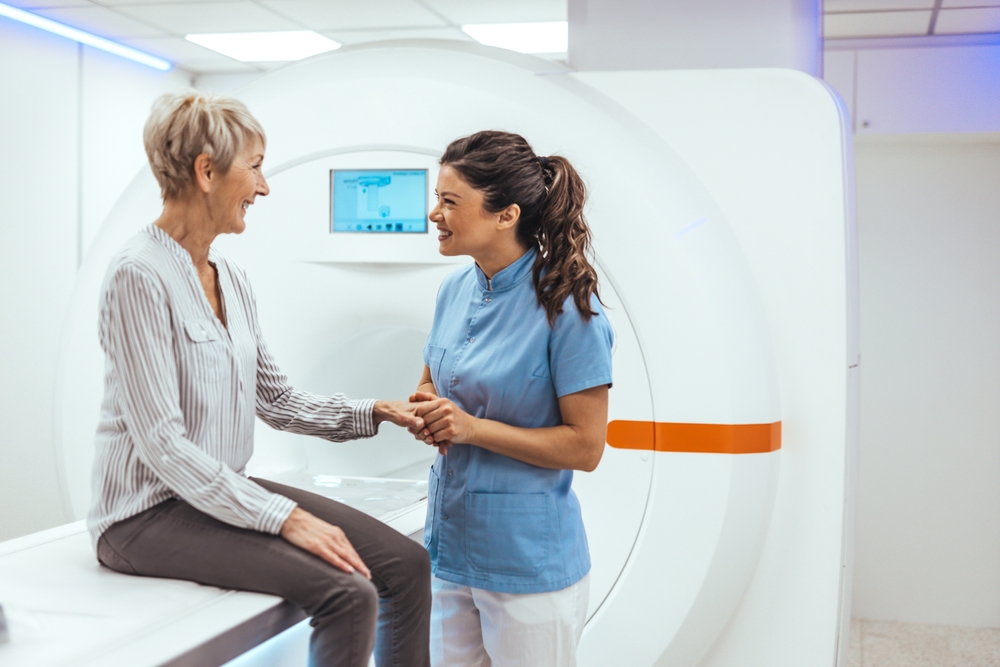
A full-body MRI screening is one of the calmer medical experiences you will have all year, which can be a small surprise the first time. There is no needle, no injected dye, no radiation, and no follow-up nausea. The scanner is quiet by hospital standards, the suite is climate-controlled, and the team at MRI Wellness in Charleston is built around making the hour feel as routine as a regular check-up. This guide walks through the full day from the time you schedule through the conversation that follows your results.
A full-body MRI screening at MRI Wellness takes about an hour. You arrive 15 minutes early to complete a safety questionnaire, change into clinic-provided clothing, and lie still inside a 1.5T MRI scanner while it captures detailed images of your brain, spine, chest, abdomen, and pelvis. No contrast dye is used, no ionizing radiation is involved, and no fasting is required for the standard whole-body protocol. Within several days you receive a written report from one of our board-certified radiologists, with the option to schedule a follow-up conversation to walk through the findings.
Before Your Scan: Scheduling and Preparation
You can book a scan directly without a referral. Most patients call or use the website, talk with the team for a few minutes about which scan fits their goals, and pick a date. The most common choices are the Whole Body Scan, the Brain & Spine scan, and the Torso scan. The team confirms pricing, FSA / HSA eligibility, and any financing questions on the same call so there is no uncertainty before the appointment.
Before your scan, you complete a brief safety questionnaire. The questions cover anything that could interact with the MRI’s magnetic field: implanted devices like pacemakers, certain types of surgical clips or stents, recent surgeries, and pregnancy status. The questionnaire is straightforward, and the team reviews each answer with you. If anything in your history needs an extra look, you will hear from a team member before scan day. Leave anything metal in the car — jewelry, watches, hairpins, piercings, and clothing with metal fasteners — and the clinic provides comfortable clothing to change into. You do not need to fast for the standard Whole Body Scan; eat normally and stay well-hydrated.
During the Scan: The Hour Inside the Magnet
Plan to arrive about 15 minutes before your scheduled time. You will be greeted by the front-desk team, complete any last paperwork, and meet the technologist who will run your scan. There is no rush. The team has done thousands of these scans and knows the value of an unhurried welcome.
The technologist helps you lie comfortably on the padded MRI table, positions a small coil over the region being scanned for sharper images, and gives you soft earplugs or headphones and a call button. The scanner is open at both ends, well lit, and ventilated. You will hear a series of rhythmic knocking sounds — that is the magnet’s gradient coils doing their job, and it is normal. The technologist’s voice comes through the speaker between sequences to let you know what is next and to check in. Your job is to lie still and breathe normally. For a small number of sequences, you will be asked to hold a short breath, generally no longer than 15 to 20 seconds at a time. If small enclosed spaces are difficult for you, tell the team in advance — we can walk you through the room, demonstrate the scanner, and talk about whether a brief, prescribed anti-anxiety option from your physician would be useful. There is no pain at any point.
After the Scan: Results and Conversation
You change back into your clothes and head out. There is no recovery period. You can drive yourself, go back to work, pick up the kids, or carry on with the rest of your day exactly as planned.
Our Radiologists personally reviews every MRI Wellness scan. We look at images from the brain, spine, chest, abdomen, and pelvis, and write a structured report that explains what the images showed and how to interpret each finding. The goal is calm clarity, not jargon. You receive the written report within several business days through a secure portal, and the team will let you know when it is ready. The report is yours to keep and to share with your primary-care physician or any other clinician you choose. If the report contains anything that benefits from a conversation, you have the option to schedule a follow-up. Most reports are reassuring. Some include incidental findings — small benign things radiologists commonly see that almost always require no action. Our companion guide on incidental findings explains in detail what those mean and how to read them.
What “Common Findings” Usually Mean
Patients often ask whether the scan is likely to find something. The honest answer is that whole-body MRI commonly identifies one or more incidental findings — small features that are visible on the images but that are usually benign. Examples include simple kidney cysts, small liver hemangiomas, benign thyroid nodules, and bone islands. The radiologist’s job is not just to spot these but to characterize them carefully so you know which need attention and which simply confirm that your body is doing fine. About one in twenty scans surfaces something genuinely useful for ongoing care; the rest function as a reassuring baseline against which future scans can be compared.
Ready to Book Your Scan?
If you have questions specific to your situation — implants, claustrophobia, prior imaging history, or whether the Whole Body Scan or the more focused Brain & Spine option is the right starting point — the team is happy to walk through them on a short call. You can reach the clinic through the contact page, or read more about the Whole Body MRI scan directly.
Frequently asked questions
How long does a full-body MRI take?
The scan itself takes about an hour. Add roughly 15 minutes on either side for arrival, paperwork, changing, and the welcome conversation with your technologist.
Will I be inside a closed tube the whole time?
The scanner is open at both ends, well lit, and ventilated. Many people find it less enclosed than they pictured. If small spaces are difficult for you, tell the team in advance — we can walk you through the room before scan day.
Is there any radiation or contrast dye?
No. MRI uses a magnetic field and radio waves. There is no ionizing radiation, and the MRI Wellness Whole Body Scan does not use contrast dye.
Will I feel anything during the scan?
The scan itself is painless. You will hear rhythmic knocking and feel the table gently move between sequences. Some sequences ask for a short breath-hold of 15 to 20 seconds, but most of the hour is simply lying still and breathing normally.
When do I get my results?
Within several business days. You receive a written report through a secure portal, with the option to schedule a follow-up conversation if anything is worth discussing in person.
Do I need to fast?
No, not for the standard Whole Body Scan. Eat and hydrate normally. If a specific abdominal protocol calls for fasting, the team will tell you ahead of time.
What if the scan finds something?
Most findings are benign and require no action. Where a finding does warrant follow-up, the report explains the recommended next step in plain language. Many patients share the report with their primary-care physician, and the MRI Wellness team is glad to walk through the report on a follow-up call.
Sources
- ACR Manual on MR Safety — American College of Radiology
- Magnetic Resonance Imaging (MRI) of the Body — RadiologyInfo.org (RSNA/ACR)
- MRI (Magnetic Resonance Imaging) — U.S. Food and Drug Administration
- Get Certified in Diagnostic Radiology (DR) — American Board of Radiology
- MRI — Mayo Clinic