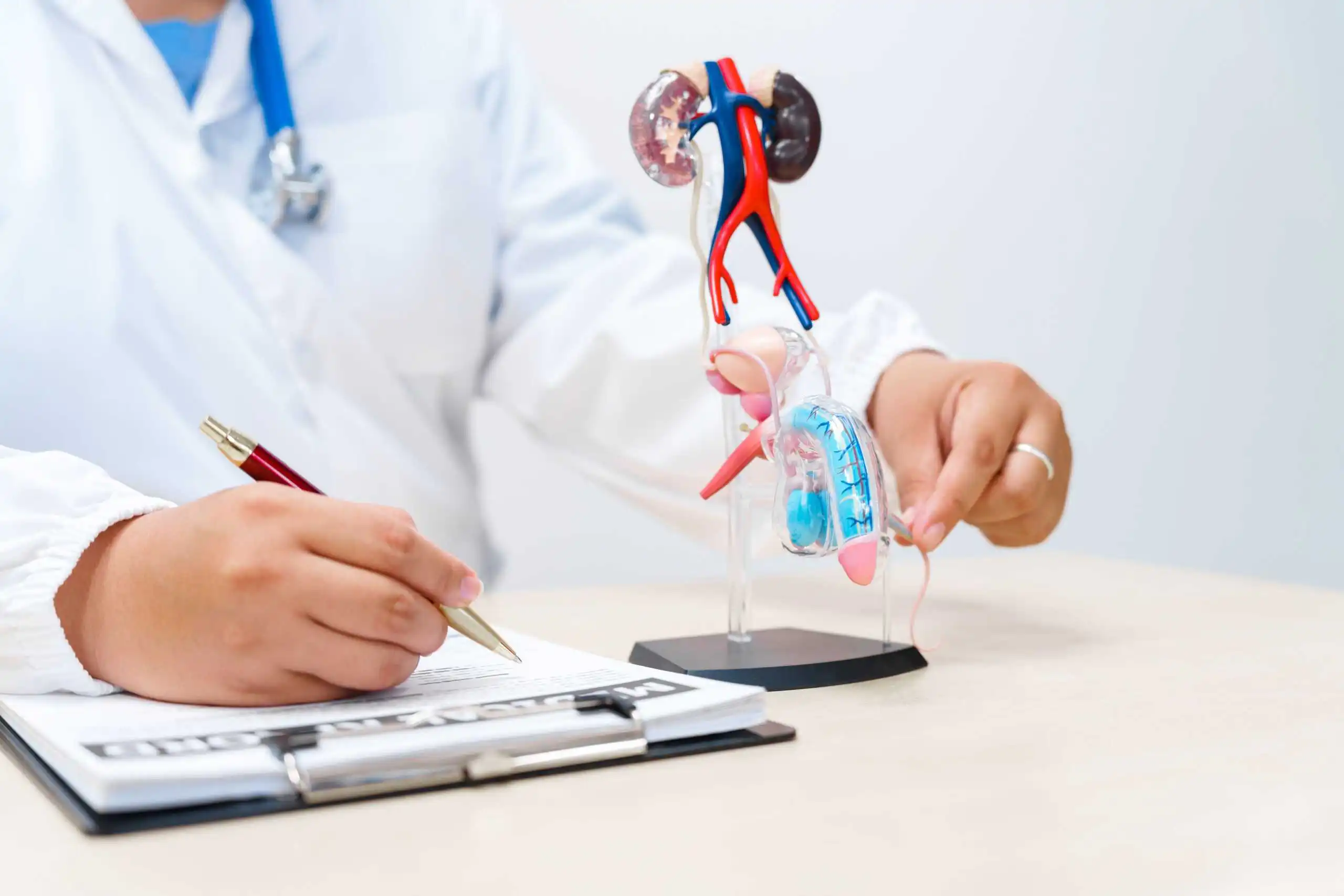
According to the American Cancer Society, about one in 8 men will be diagnosed with prostate cancer during their lifetime.
September marks Prostate Cancer Awareness Month, a time dedicated to raising awareness and providing education to those at potential risk for developing one of the most common types of cancer diagnosed in men in the United States.
With roughly over 313,000 new cases of prostate cancer estimated in the United States in 2025, our team is answering the most commonly asked questions surrounding this disease and how we may be able to help when it comes to your healthcare journey.
Is Prostate Cancer Genetic?
One of the most commonly asked questions is whether genetics plays a role in prostate cancer, and the answer is a bit complicated.
The American Cancer Society states that “having a father or brother with prostate cancer more than doubles a man’s risk of developing the disease,” suggesting a genetic risk factor for the disease. However, many prostate cancers occur in men without a family history of the condition.
While genetics plays a role in the risk of developing prostate cancer, it is not the only risk factor to consider. Other factors that can increase your risk of developing the condition include:
- Older age: The risk of prostate cancer rises after the age of 50 years
- Race/ethnicity: This type of cancer develops more often in African American men and Caribbean men of African ancestry. The reasons for this are unclear.
- Inherited genetic mutations: Inherited variants of the BRCA1 or BRCA2 gene can increase the risk of prostate cancer, as can those with Lynch syndrome
How is Prostate Cancer Diagnosed?
Prostate cancer can often be found in its early stages in two ways: by testing for prostate-specific antigen (PSA) levels in the blood or through a digital rectal exam. However, these tests can result in false positives or overdiagnosis because not all prostate cancers are the same.
How to Detect Prostate Cancer
If the results from the PSA blood test or the rectal exam suggest you may have prostate cancer, you will likely need a biopsy before a prostate cancer diagnosis can be given.
During the prostate biopsy, your doctor will conduct an imaging test to look at the prostate, then insert a thin, hollow needle into the prostate.
This needle will remove a small piece of prostate tissue that will be sent to a lab for further cancer testing.
Symptoms of Prostate Cancer, and Can It Cause Back Pain?
Screening is not a necessity for everyone, nor is it a foolproof way to catch prostate cancer. Whether you undergo regular screenings or not, it’s critical to your health to be able to spot the signs and symptoms of prostate cancer.
In its early stages, prostate cancer will typically cause no symptoms. If symptoms do occur, which is uncommon, you may experience the following:
- Urinary issues, such as a slow or weak urinary stream or the need to urinate more frequently
- Blood in the urine or semen
In the advanced stages of prostate cancer, you may experience the following symptoms:
- Difficulty getting an erection
- Pain in the back, hips, chest, and other areas
- Weakness or numbness in the legs or feet
- Weight loss
- Loss of bladder or bowel control
- Fatigue
What the USPSTF Actually Recommends
Prostate screening is a genuine judgment call and the U.S. Preventive Services Task Force treats it that way. For men aged 55 to 69 it gives PSA screening a Grade C: the decision should be an individual one, made after talking with your clinician about both benefits and harms. Those harms are real, including false positives, unnecessary biopsies, and the overdiagnosis and overtreatment of cancers that would never have caused symptoms. For men 70 and older, the Task Force recommends against routine PSA screening.
None of that means screening should be skipped. It means the conversation with your doctor is the screening step that matters most.
Where Prostate MRI Actually Fits
If your PSA comes back elevated, the next step is often a multiparametric MRI of the prostate, and it is worth understanding what that is.
It is a dedicated scan of one organ at very high resolution, combining specialised sequences including diffusion-weighted imaging and, in the full protocol, contrast-enhanced imaging. A radiologist scores the result on a standardised five-point scale called PI-RADS. Its job is to tell your urologist whether you need a biopsy at all, and if so exactly where to aim it. The PRECISION trial found this approach outperformed standard biopsy while reducing detection of insignificant cancers that would only have led to unnecessary treatment.
Note the sequence: PSA first, then targeted MRI. The MRI does not replace the blood test. It makes what happens after the blood test far more precise.
What Our Whole-Body Scan Can and Cannot See
Plainly, because this matters.
A whole-body screening MRI images the prostate as part of the pelvis. It can show an enlarged gland, obvious asymmetry, a sizeable mass, or signs of spread. Those are findings worth knowing and worth acting on, and we would report them. You can read more in our health library entry on the heterogeneous prostate.
What it cannot do is take the place of a dedicated multiparametric prostate MRI. That exam images one organ at far higher resolution using sequences our screening protocol does not run, and produces a PI-RADS score a urologist can act on. Ours does not produce a PI-RADS score. It is not a substitute for a PSA test, and it is not a substitute for the conversation that should surround one.
If you are a man in the age range where screening is on the table, talk to your physician about PSA. Think of a whole-body scan as a look at the wider picture rather than as a prostate test.
Prostate Cancer Awareness, Practically
Know your risk factors, particularly family history, African ancestry, and inherited BRCA1, BRCA2 or Lynch syndrome variants. Have the PSA conversation with your doctor if you are in the relevant age range. And if you want a broad structural baseline alongside that, schedule a scan or talk to our team, and we will be honest about what it covers.
This article is for general education and is not medical advice.
Frequently asked questions
Should I get a PSA test?
For men aged 55 to 69 the U.S. Preventive Services Task Force gives PSA screening a Grade C, meaning the decision should be an individual one made after discussing benefits and harms with your clinician. For men 70 and older it recommends against routine PSA screening. The harms are real, including false positives, unnecessary biopsies and overtreatment of cancers that would never have caused symptoms. The conversation with your doctor is the step that matters most.
Where does prostate MRI fit in?
After an elevated PSA, not before. Multiparametric prostate MRI is a dedicated high-resolution scan of one organ, combining specialised sequences and scored on a five-point scale called PI-RADS. Its job is to tell your urologist whether a biopsy is needed and where to target it. The PRECISION trial found this outperformed standard biopsy while reducing detection of insignificant cancers.
Can a whole-body MRI screen for prostate cancer?
No. It images the prostate as part of the pelvis and can show an enlarged gland, obvious asymmetry, a sizeable mass or signs of spread, all worth reporting. But it runs at far lower resolution than a dedicated prostate protocol, does not use the required sequences, and cannot produce a PI-RADS score. It is not a substitute for a PSA test.
Is prostate cancer genetic?
Partly. Having a father or brother with prostate cancer more than doubles a man’s risk, though many cases occur in men with no family history. Inherited BRCA1 or BRCA2 variants and Lynch syndrome also raise risk. Age is the biggest factor, with risk rising after 50, and the disease is more common in African American men and Caribbean men of African ancestry for reasons that remain unclear.
What are the symptoms of prostate cancer?
Early prostate cancer typically causes no symptoms at all, which is why the screening conversation matters. When symptoms do occur they may include a slow or weak urinary stream, needing to urinate more often, or blood in the urine or semen. Advanced disease can cause pain in the back, hips or chest, weakness or numbness in the legs, difficulty with erections, weight loss or fatigue.
Sources
- Prostate Cancer: Screening — U.S. Preventive Services Task Force
- Early Detection of Prostate Cancer: AUA/SUO Guideline — American Urological Association
- MRI-Targeted or Standard Biopsy for Prostate-Cancer Diagnosis (PRECISION) — New England Journal of Medicine, 2018
- Key Statistics for Prostate Cancer — American Cancer Society
- Prostate Cancer Risk Factors — American Cancer Society